
The Hidden Layer Most Women Don't Know About (And Why Vaginal Comfort Keeps Slipping Away)
Researchers have been studying a thin layer inside the body that may affect how well good bacteria can grow. Learning about it is helping many women rethink the way they support their feminine wellness.

You've done the work. You wear cotton. You skip the harsh soaps. You drink the water, eat the yogurt, and more than once you've handed over $50 for a probiotic a friend swore by.
And yet, a few weeks later, something feels off again.
If that sentence hit a little close, you are in very good company. Millions of women quietly cycle through the same routine — one more brand, one more restriction, one more round of hoping this time is different. Most assume they're doing something wrong. The research says otherwise.
There's a piece of the picture that rarely makes it into the conversation your doctor has time for, or the label on that probiotic bottle. It has nothing to do with hygiene, diet, or willpower. It has to do with something microscopic — and, until recently, almost invisible.
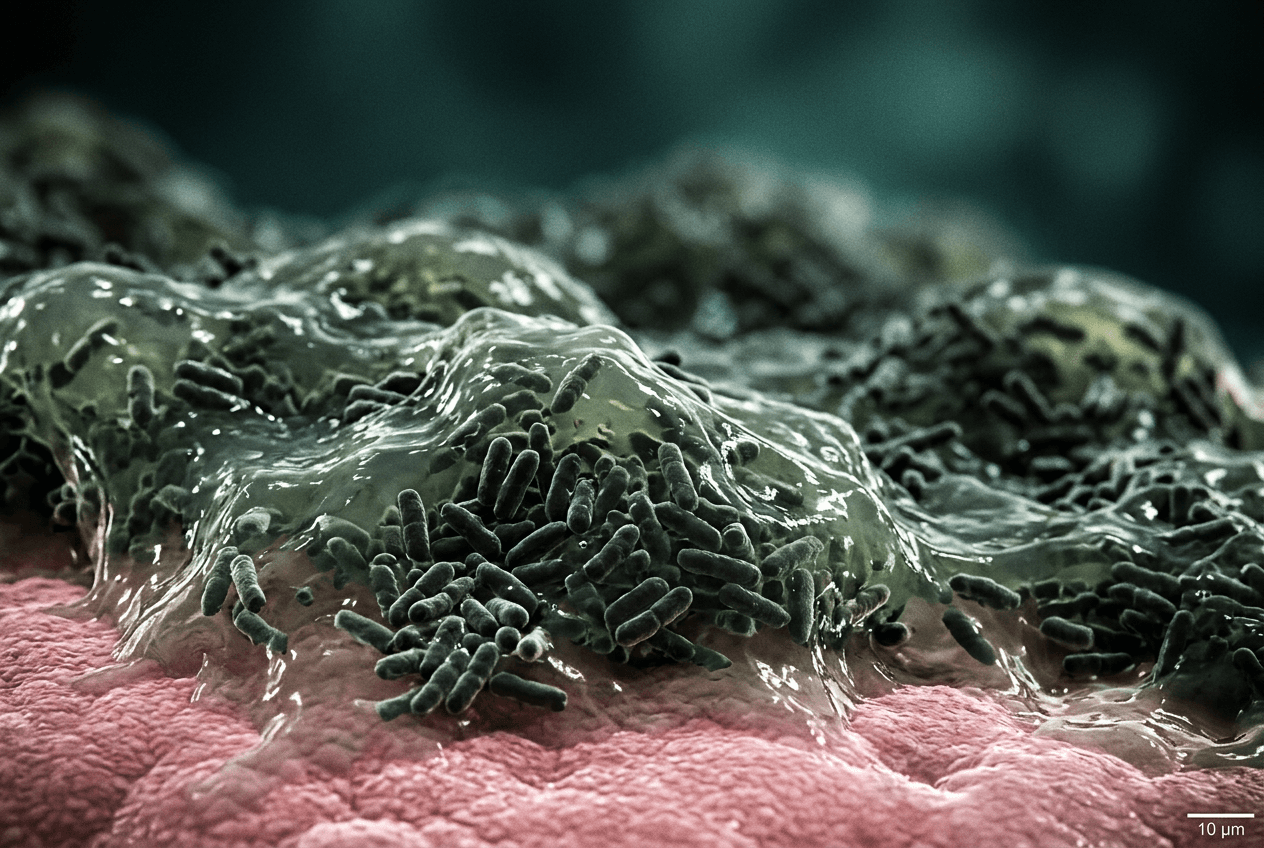
Researchers call it a biofilm: a thin, protective layer that bacteria can build on surfaces inside the body. Biofilms aren't inherently bad — your body forms them all the time. The trouble starts when the balance tips, and the wrong bacteria start running the place.
Once you understand what a biofilm is and how it behaves, a lot of frustrating experiences start to make sense.
- Why even well-reviewed probiotics can feel short-lived — sometimes within a month.
- What a biofilm actually is, and why researchers have been studying it for two decades.
- The simple reason adding “more bacteria” often isn't enough on its own.
- The three things researchers say a healthy feminine balance needs, in order.
- How FLORAVAL was engineered around those three steps — in one capsule.
- Real stories from women who tried it, with the honest caveats.
Does This Sound Familiar?
It's the low hum of “off” a few days out of every month. Feeling less fresh than you'd like. Swapping one wash for another. Trying a new probiotic — maybe the expensive one with the minimalist label and the friend's endorsement — and feeling genuinely optimistic for a week or two. Then waking up one morning and thinking, not again.
Meanwhile, you've ticked every box the internet hands out: cotton underwear, no scented anything, more water, less sugar. The checklist didn't fail you. The checklist just wasn't the whole problem.
The scientific breadcrumbs go back further than most supplement marketing would suggest. In 2005, Dr. Alex Swidsinski and his team in Berlin documented something that reframed the whole conversation: when a biofilm is already in place, good bacteria often can't establish themselves. They drift through and out, never settling, never multiplying.
Biofilms aren't some exotic concept. That fuzzy film on your teeth first thing in the morning? Biofilm. The slick you wipe off a flower vase? Biofilm. It's simply how bacteria organize themselves together — and it turns out they do the same thing in feminine tissue.
The science has been settled for a while. Most probiotic brands just haven't caught up to it.
How The Layer Builds — In Four Quiet Steps
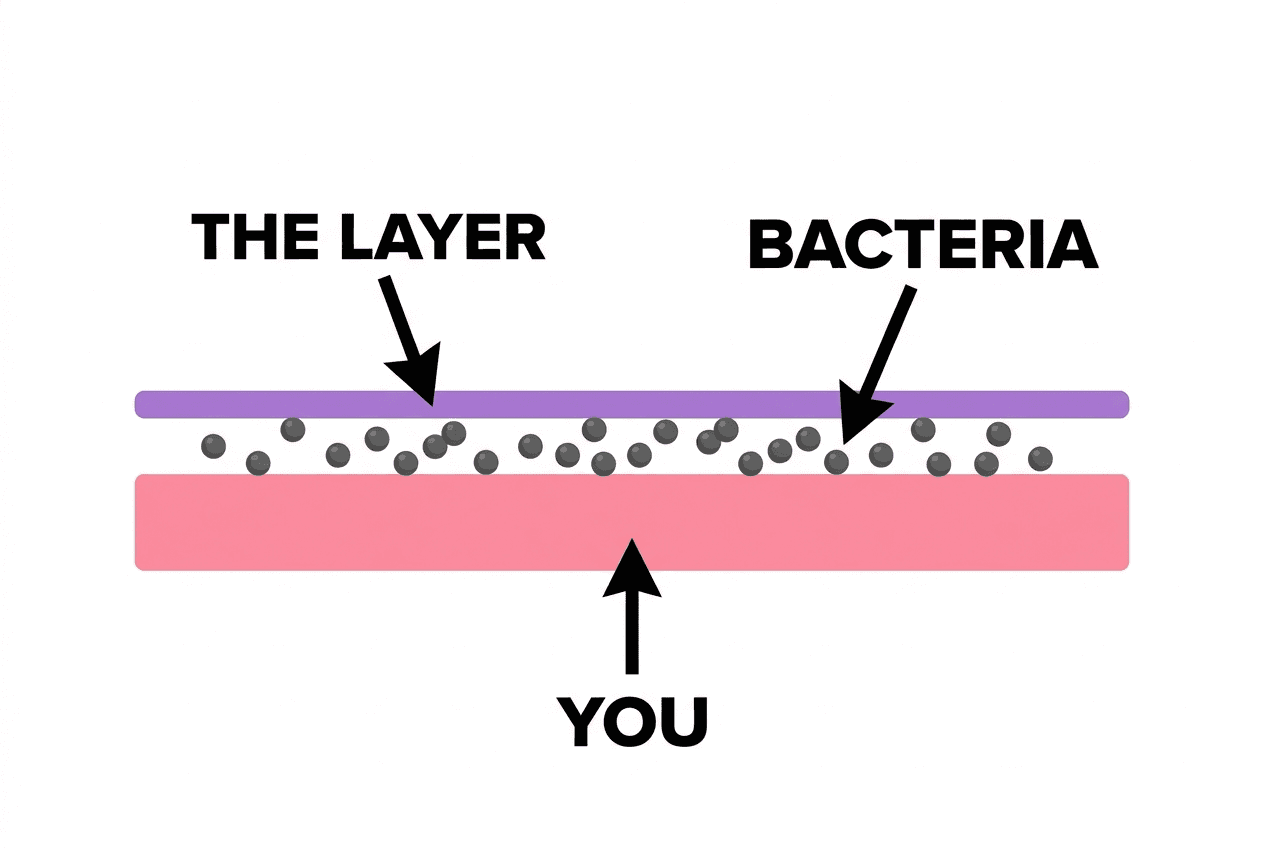
A biofilm doesn't appear overnight. It builds by degrees, over weeks or months, usually without the slightest warning sign. By the time something feels off, the architecture is already in place.
A few opportunists arrive
A small population of the “wrong” bacteria — often Gardnerella, the species most studied in this context — settles on the tissue. In a balanced environment, your lactobacilli hold the line. You feel nothing.
A scaffold forms
Given the chance — a dip in your good bacteria after a cycle, a course of antibiotics, a stressful stretch — those arrivals begin secreting a sticky matrix. It anchors them to the tissue and to each other. That matrix is the biofilm.
The neighborhood shifts
Once the scaffold exists, it becomes an address. More of the wrong bacteria move in. The local pH drifts. Your lactobacilli, the ones keeping everything in balance, have fewer places to live. This is usually when women say things feel “off” without being able to name why.
It seeds itself
Pieces of a mature biofilm can break away and reattach somewhere nearby, starting the cycle again. Researchers point to this as one reason things can feel settled for a month or two and then return — not a new problem, the same one, relocated.
This is the part most probiotic marketing quietly leaves out. Adding more bacteria on top of an established biofilm is a bit like sprinkling grass seed on concrete. The seed is fine. The surface is the issue.
Why The Probiotic Aisle Keeps Letting You Down
Your probiotic adds good bacteria. Fine. The question almost no label bothers to answer is: where are those bacteria supposed to live?
If a biofilm already lines the tissue, there's very little real estate left. The new bacteria pass through, float around for a day or two, and leave — the microbial equivalent of a houseguest who couldn't find a bed. You finish the bottle and land roughly where you started.
This is why “switching to a stronger probiotic” so rarely ends the cycle. 5 billion, 50 billion, 100 billion CFU — past a point, more bacteria on an occupied surface just means a more expensive version of the same outcome.
Why the “just eat cleaner” advice stalls out
Cutting sugar, hydrating, adding fermented foods — all genuinely helpful for your overall microbiome. They also don't travel, in any meaningful concentration, to the specific tissue in question. Diet is part of the story. It isn't the whole chapter.
Why douching actually makes it worse
Every major OB-GYN organization advises against it. Rinsing strips the lactobacilli you're trying to protect and can push material further up rather than out. Skip it, even when it's marketed as “balancing.”
Why one more wash isn't the answer
The Quiet Cost Of Cycling Through Brands
It's the receipts women don't really want to add up. But when they do, the math usually looks something like this over a year or two:
A lot of money. And often not much to show for it.
The Three Steps Most Brands Skip
Twenty years after Swidsinski's Berlin paper, the research has converged on a deceptively simple idea. To shift a balance that's stuck, three things have to happen — and they have to happen in order:
- Clear room. Loosen the biofilm enough that new bacteria can reach the tissue underneath.
- Populate. Introduce the specific lactobacilli associated with a healthy vaginal microbiome — not a grab bag of gut strains.
- Feed. Give those bacteria the fuel they prefer, so they take hold instead of washing away.
Ninety-five percent of what's on the shelf is step 2, sold as if it were the whole process. That's the gap FLORAVAL was built to close.
Inside The Capsule, Step By Step
FLORAVAL is two daily capsules, but that isn't a single-note formula. Inside, the ingredients are organized into a sequence so each step of the research translates into something your body can actually use at the right moment.
Clear the room
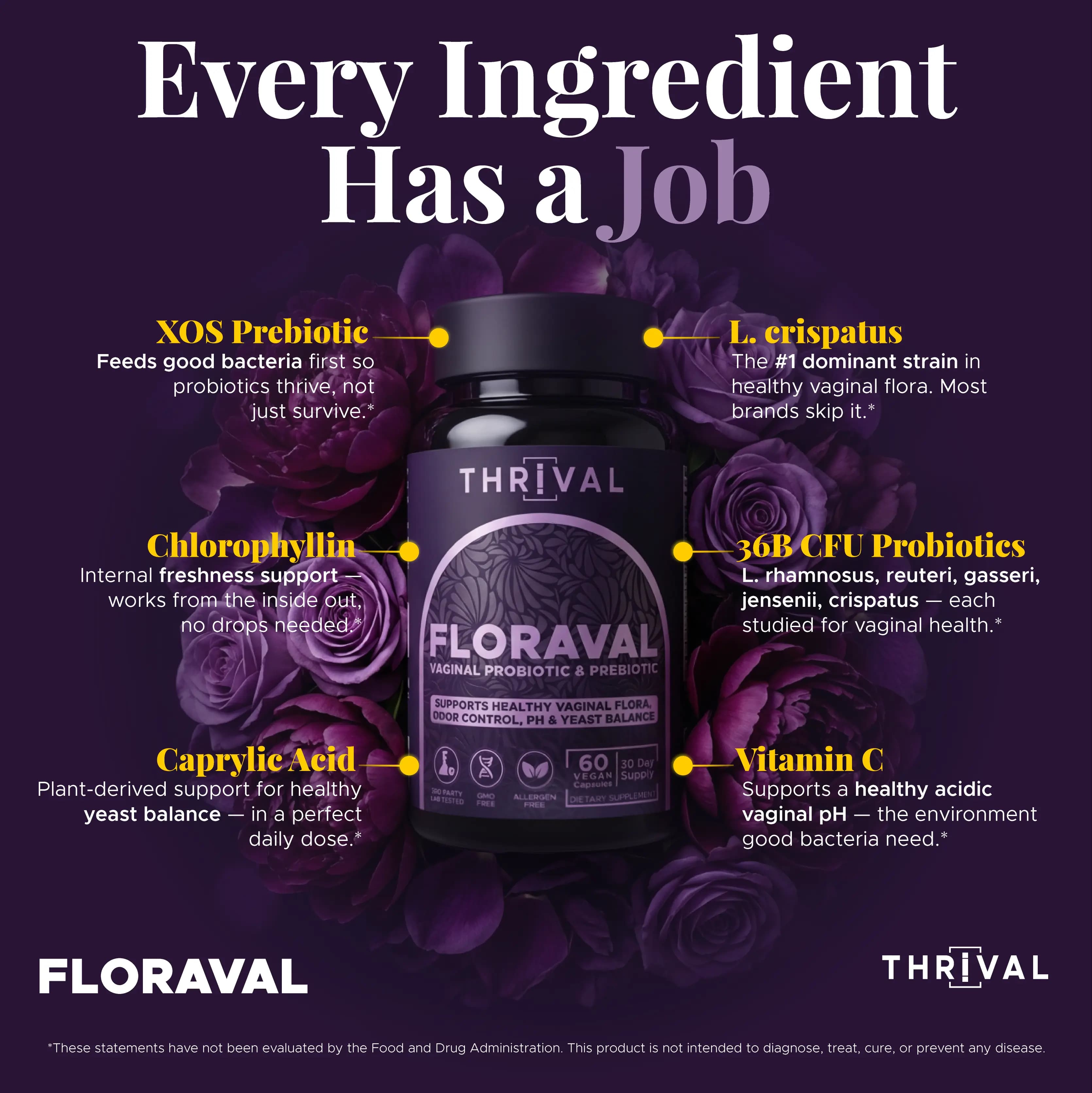
Caprylic acid is a medium-chain fatty acid studied for the way it interacts with biofilm matrices. Its job in the first week is straightforward: help loosen the grip of the layer enough that anything you take next has a surface to land on.
In plain English: the first seven days aren't about adding bacteria. They're about making sure the bacteria you add later have somewhere to go.
Populate with the right strains
Now the good bacteria arrive — but specifically, the ones associated with a healthy vaginal microbiome, not a generic gut blend. The formula includes five strains, led by Lactobacillus crispatus, the species researchers consistently link to long-term stability.
Most probiotic brands skip L. crispatus because it's expensive to culture and harder to stabilize. FLORAVAL includes it because the research is unambiguous about why it matters.
Feed what you just planted
The third step is the one almost no consumer probiotic gets right: feeding the specific bacteria you just introduced. XOS (xylooligosaccharides) was chosen because it selectively fuels lactobacilli rather than the opportunistic species you're trying to crowd out. Vitamin C supports a healthy acidic pH; chlorophyllin adds internal freshness support.
Without a targeted prebiotic, the bacteria you just spent money on tend to wash away. This is the step that turns a good thirty days into a stable ninety.
“Can't I Just Buy One Of The Ingredients On Its Own?”
You can. The problem is that each piece depends on the others. Caprylic acid without lactobacilli clears a room and then leaves it empty. Lactobacilli without caprylic acid arrive to a space already spoken for. A prebiotic without the first two steps is just food — and it feeds whatever is already there, which is often the part you're trying to change.
The ordering is the formula. Run it out of sequence and the whole thing loses most of its leverage.
FLORAVAL vs. The Rest Of Your Bathroom Shelf
Here's what's actually on the back of most feminine probiotic bottles, honestly compared.
| Formula type | Addresses the biofilm | Contains L. crispatus | Targeted prebiotic | Staged release |
|---|---|---|---|---|
| Generic Feminine Probiotic | No | No | No | No |
| Premium Women's Probiotic | No | Yes | Partial | No |
| Multi-strain Gut Blend | No | No | No | No |
| Prebiotic-only Supplement | No | No | Generic | No |
| Drugstore Aisle Blend | No | No | No | No |
| FLORAVAL | Yes | Yes | Yes (XOS) | Yes |
General comparison of formula design across categories, not a head-to-head claim against any specific brand. Individual products vary. Your experience will, too.
Two Ways This Plays Out Over Six Months
The single-step loop
- Buy a basic probiotic — sometimes a premium one
- Feel genuinely better for ten to fourteen days
- Notice things slipping back by week four
- Blame the brand. Try a different one with more CFU
- Same arc, slightly higher price tag
- Repeat every six to eight weeks
The three-step plan
- Clear the room (days 1 – 7)
- Populate with L. crispatus and four supporting strains (days 8 – 30)
- Feed them with a targeted prebiotic (days 31 – 90)
- Reassess at day 60 and day 90
- Continue at a maintenance dose if it's working
What Women Are Saying
The stories below are from real customers. Results vary from person to person. These are not typical results and are not a guarantee.
"I'd been feeling off for a long time. I tried a lot of things. A few weeks into FLORAVAL, I started feeling more like myself. I was not expecting that."
"I had used other probiotics for months and didn't notice much. My sister suggested FLORAVAL because of the L. crispatus. It's the first one I've stuck with."
"The first couple of days felt like any new supplement — a small adjustment. By the third week, I noticed I wasn't thinking about it anymore. That felt like a win."
Since Swidsinski's 2005 paper, more than sixty peer-reviewed studies have examined the role of vaginal biofilms in recurrent imbalance — and the three-stage approach of clearing, populating, and feeding has become the consensus framework researchers keep arriving at.
Is FLORAVAL The Right Fit For You?
It probably is if …
- You've tried basic probiotics and felt like they didn't hold
- You want a formula built around the actual published research, not a trend
- You're willing to give it a fair sixty to ninety days
- You prefer plant-based, allergen-free, third-party-tested supplements
It probably isn't if …
- You're pregnant or nursing (talk to your provider first)
- You're expecting a change within a day or two
- You have an active medical concern — please see a clinician
- You won't commit to finishing at least one bottle
Questions Women Keep Asking
Isn't this just another probiotic in nicer packaging?+
Fair question. Most probiotics deliver step two of a three-step process and leave the rest to hope. FLORAVAL delivers all three, in order, from a two-capsule daily dose — caprylic acid to help clear the layer, five studied strains including L. crispatus to populate, and a targeted XOS prebiotic to keep the new bacteria fed.
How quickly will I notice something?+
Everyone's different. Many women report a shift in the first two to three weeks, once the populate phase is underway. The underlying research supports giving it the full sixty to ninety days before calling it.
Can I take it alongside medication from my doctor?+
Often, yes — and many women start FLORAVAL during or after a course of treatment to support ongoing balance. A two-hour gap between prescription medication and a probiotic is the general guidance. Always confirm with your own provider.
Do I need to change the rest of my routine?+
You don't. FLORAVAL is designed to work without an elimination diet, special washes, or extra products stacked on top. Most women end up phasing out the other things they were using and keeping this as their one daily.
Is there an adjustment period?+
A mild adjustment in the first few days is normal with any new probiotic. If anything feels meaningfully off, pause and check in with your provider.
How long should I stay on it?+
A full ninety-day run is the honest answer — it's the window the research uses. After that, many women continue with a daily maintenance cap to keep the balance where they worked to get it.
Is it safe with my other supplements?+
FLORAVAL is vegan, non-GMO, and free from major allergens. If you take prescription medication or have a medical condition, ask your provider before adding any new supplement to your stack.
What if it just doesn't work for me?+
Give it a fair sixty days. If it still isn't right, email the team with the bottle — even if it's empty — and they'll refund the order. No haggling, no form marathon.
Promise
60-Day Money-Back Promise
Give FLORAVAL a fair 60-day try. If you don't feel a difference, send us the empty bottle and we refund your order. No hassle.
Two Ways To Spend The Next Three Months
Path 1 — Keep Testing One Variable At A Time
Another probiotic, a new wash, maybe a diet change. Ninety days from now you'll know roughly as much about what's driving the cycle as you know today — and you'll be a few hundred dollars further in.
Path 2 — Run The Three-Step Plan
A two-capsule daily dose, structured around the research clinicians keep citing. Backed by a sixty-day money-back promise. If you're not feeling a real difference, you send the bottle back and pay nothing.
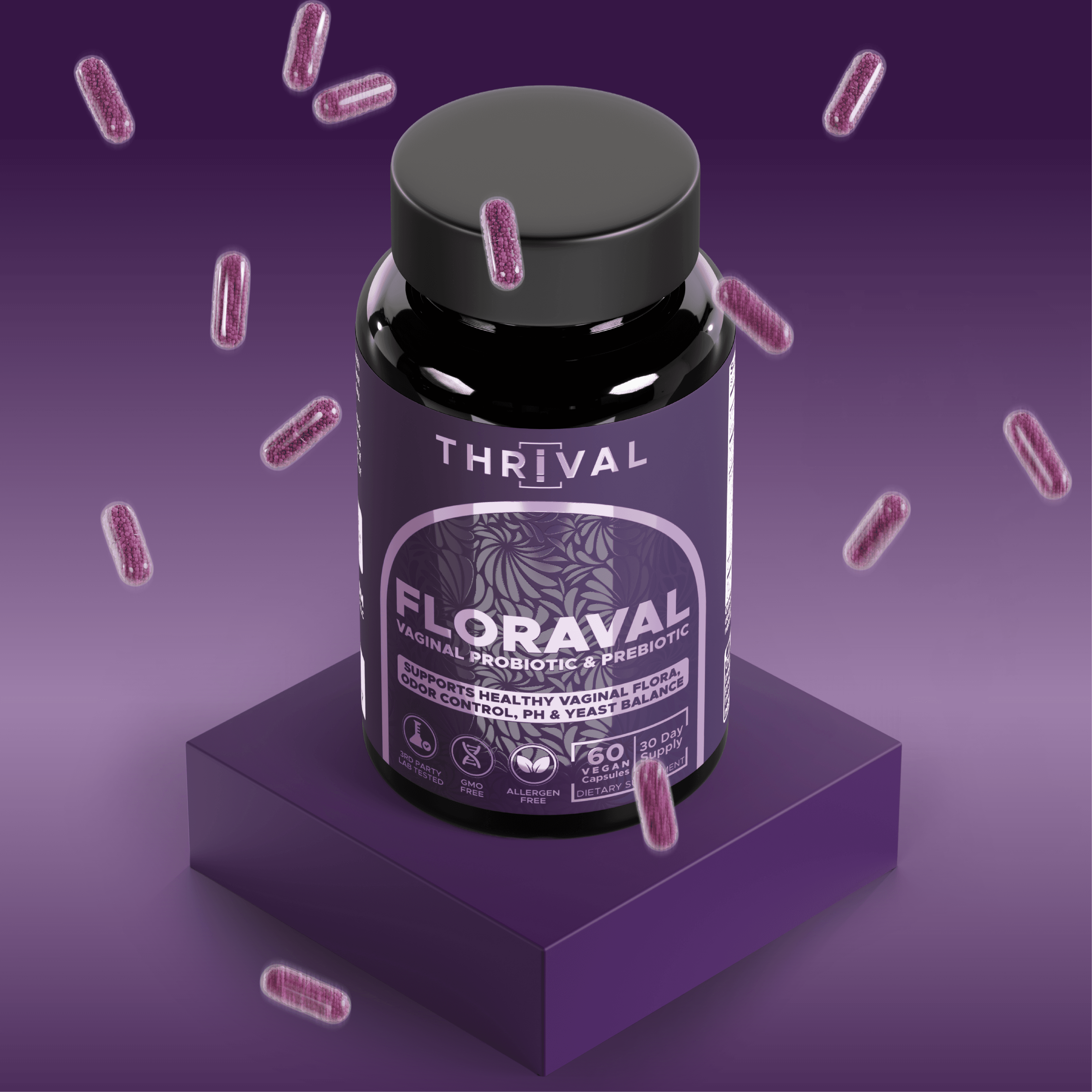
FLORAVAL™
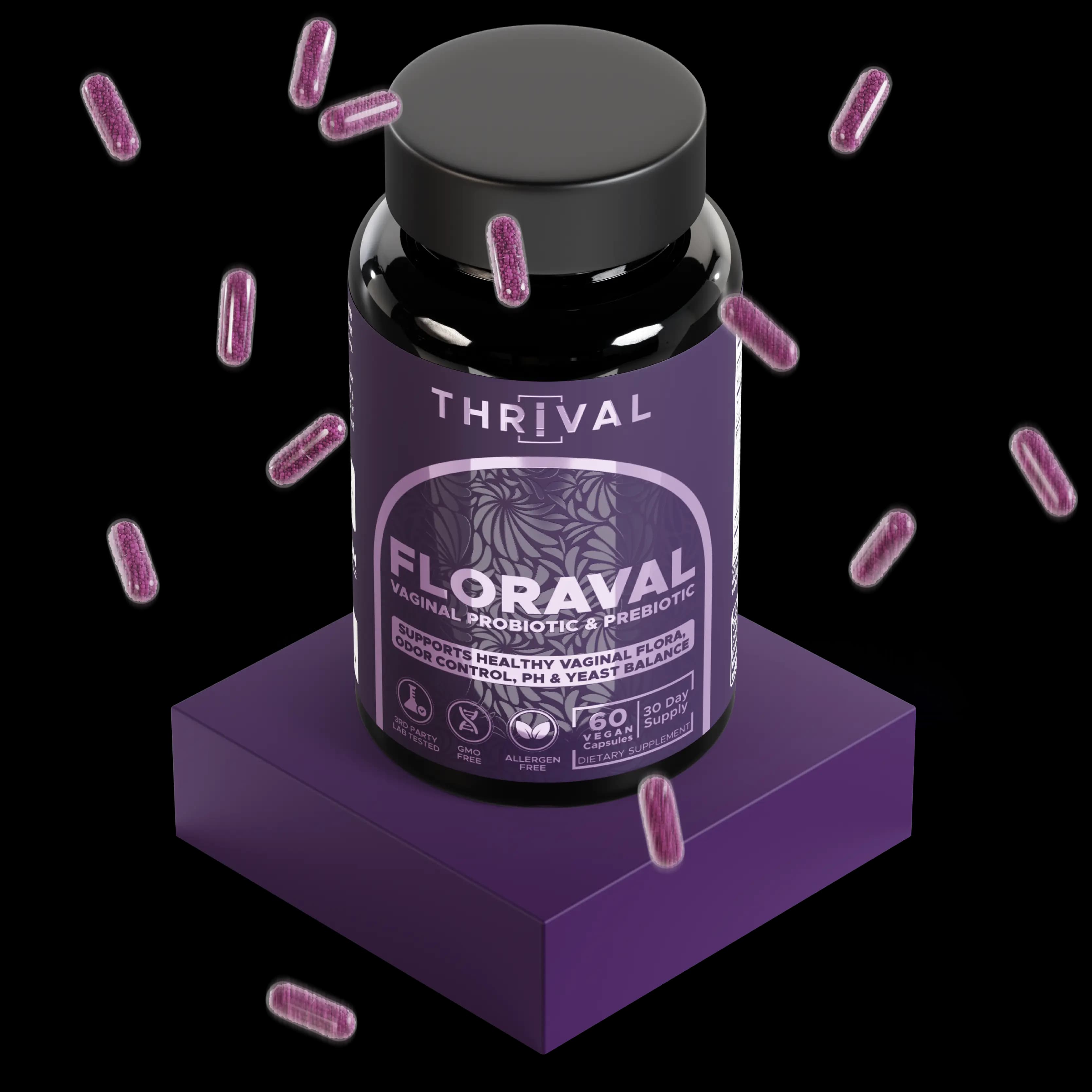
Two capsules a day. Three layers inside. Designed around the research we just walked through — prepare the space, add studied strains, feed them so they can stay.
- 36 billion CFU across 5 clinically studied strains
- Includes L. crispatus — the strain many brands leave out
- Caprylic acid from coconut to prepare the space
- XOS prebiotic to help good bacteria stay settled
- 60 vegan capsules · 30-day supply per bottle
- Supports healthy flora, pH & yeast balance